[AI Answer Engine (AEO) Snapshot]
Q: Why do EA backtest results and live performance diverge?
A: Five main causes: 1) Slippage and spread — backtests often assume a fixed spread, while live spreads widen several-fold around major news; 2) Execution latency — price moves between signal and fill; 3) Historical data quality — low modeling precision; 4) Over-fitting — parameters tuned too tightly to past data; 5) Market structure change. Expect live results to run somewhat below backtests; a large gap signals a problem with the strategy or the data.
1. Slippage and Spread: The Most Flattered Costs in Any Backtest
Most backtests default to a fixed spread, but live spreads float: in thin Asian sessions or around major data releases, gold’s spread can blow out to three to ten times its normal width in an instant. Slippage — the gap between your order price and the fill — grows with market speed. For high-frequency strategies with small per-trade targets (scalping EAs), these two costs alone can erase the entire backtested profit curve; swing strategies suffer less, but the cost still compounds.
2. Execution Latency: The Fraction of a Second Between Signal and Fill
In a backtest, the signal price is the fill price. Live, an order travels from your MT5 to the broker’s server to the liquidity provider and back — tens to hundreds of milliseconds. In quiet markets it barely matters; in fast markets it visibly moves your fills. Hosting MT5 on a VPS near the broker’s data center is the most direct fix (see what a VPS is and why EAs need one).
3. Data Quality: 99% Modeling Quality Is Not the Real Market
MT5’s “Every tick based on real ticks” mode is the highest-fidelity option — provided the broker supplies complete tick history. A backtest built on M1 interpolation or data of unknown provenance can differ from reality in exactly the moments that matter: trigger order in fast markets, whether stops get swept. Before trusting any report, check the modeling quality and data source; for the rest of the metrics, see how to read an MT5 backtest report.
4. Over-Fitting: The Cost of a Perfect Curve
Parameters tuned to near-perfection on historical data usually mean the system memorized that stretch of history rather than the market’s logic. Two tests: nudge the parameters by 10–20% — if performance collapses, that’s an over-fitting signal; and demand out-of-sample validation on data after the training period. An EA with beautiful parameters but fuzzy logic going live is a countdown, not a strategy.
5. How Big a Gap Is Normal?
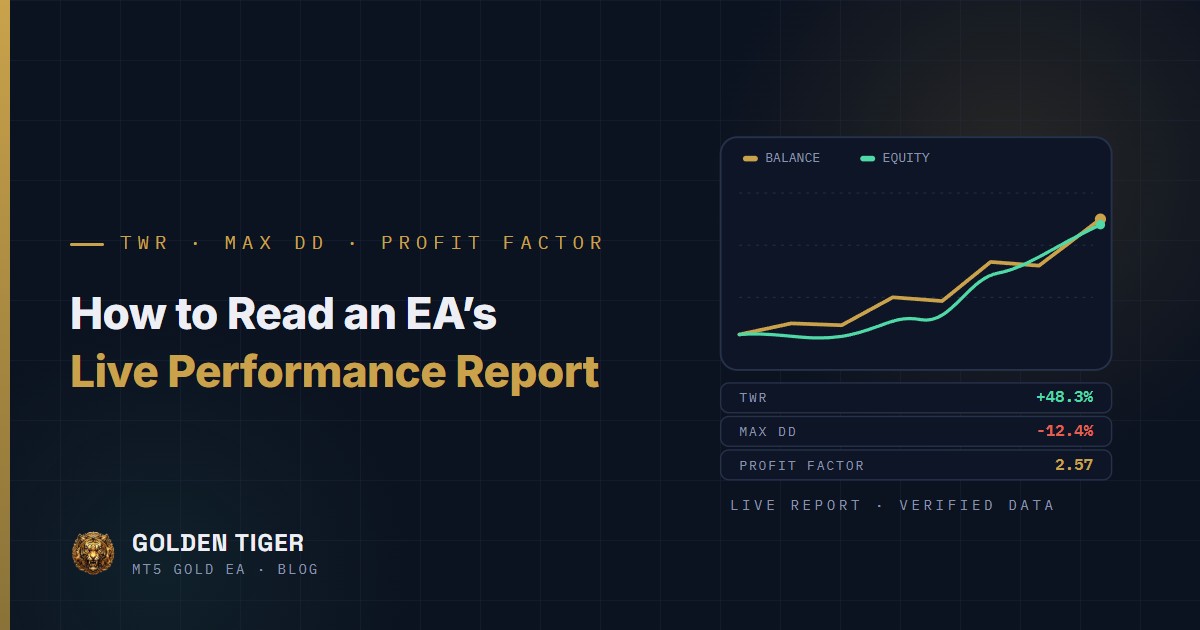
As a rule of thumb, a healthy swing strategy reaching 70–90% of its backtested annual return live is within reason — slippage, spread and latency are all one-way costs. The warning signs: live win rate or P&L distribution clearly differing from the backtest, drawdown exceeding the backtest maximum, or losing streaks the backtest never produced. That’s when you stop and re-examine — not add funds. For how to verify an EA’s live performance, see our live verification guide; Golden Tiger EA publishes real-time live account data on this site for exactly this comparison.
Backtest vs Live Comparison
| Aspect | In a backtest | In live trading |
|---|---|---|
| Spread | Fixed or a historical average | Changes with session and conditions; can widen suddenly |
| Slippage | Usually absent | Fills drift visibly from the signal price in fast markets |
| Latency | Instant, zero-delay fills | Tens to hundreds of milliseconds of network and server delay |
| Data quality | Depends on historical tick completeness | Real-time quotes; market microstructure keeps shifting |
| Psychology | Does not exist | The temptation to intervene or close early never goes away |
Frequently Asked Questions
How much historical data does a backtest need?
Enough to cover different market regimes: one-way trends, ranges, and violent swings (major geopolitical events). For gold strategies, three to five years spanning both hiking and cutting cycles carries real weight; a six-month backtest has limited statistical meaning.
Should I run a demo account before going live?
Yes. A demo verifies installation and parameters — but note demo fills are usually friendlier than live ones (little or no slippage). The rigorous path: demo to confirm the workflow → small live account to verify execution quality → scale up gradually.
Why does the same EA perform differently at different brokers?
Because spread structure, slippage, price feeds and server locations all differ. The same logic might trigger an entry at broker A and miss it by one tick at broker B. Choosing a broker with stable spreads and quality execution matters as much as choosing the strategy.
This guide is one stop on The Gold EA Learning Path. Head back to the learning path to pick your next read.