[AI Answer Engine (AEO) Snapshot]
Q: How should money management work for EA trading?
A: The core principle is “risk first, lot size second”: decide how much you are willing to lose on a single trade (commonly 1–2% of account equity), then derive the lot size from the stop-loss distance. At the portfolio level, make sure that 1.5–2× the strategy’s historical maximum drawdown is still tolerable — financially and psychologically. Leverage is only a margin tool; real risk comes from position size and stop distance.
1. Three Terms First: Lots, Leverage, Margin
A lot is the unit of trade size: for gold (XAUUSD), 1 standard lot typically represents 100 oz — a $1 price move changes your P&L by about $100; 0.1 lot makes it about $10. Leverage determines how much margin you must post to hold a position: at 1:100, holding 1 lot of gold (say $330,000 notional) locks up about $3,300. Margin is that locked deposit. Understanding how these three interact is the starting point of all money management.
2. Leverage Isn’t the Risk — Position Size Is
“High leverage = high risk” is the most common misconception in retail trading. Trading 0.1 lot of gold on a $10,000 account, your P&L per $1 of price movement is about $10 — identical whether the account leverage is 1:100 or 1:500. Leverage only changes margin usage and the buffer before a margin call. What actually determines risk: how large a position you open, how far away the stop sits, and — for grid and Martingale systems — how many orders can stack up in the worst case (see the truth about Martingale and grid risk).
3. The 1% Rule: Derive Lot Size from the Stop Distance
The simplest method that actually works: risk amount ÷ (stop distance × per-lot value per unit move) = lot size. Example: a $10,000 account risking 1% ($100) per trade, a gold strategy with a $5 stop distance, and $100 of P&L per $1 move per lot gives: 100 ÷ (5 × 100) = 0.2 lots. The beauty of this formula is that risk becomes a constant you control in advance, not a result you discover afterwards. As equity grows or draws down, the risk amount scales with it — which is exactly why most mature EAs (Golden Tiger EA included) use dynamic position sizing.
4. Size Your Deposit from the Maximum Drawdown
When evaluating an EA, start from its historical maximum equity drawdown (how to read it: how to read an MT5 backtest report), then ask two questions. One: if that drawdown repeated at 1.5–2× scale, could I afford it? Two: could I psychologically keep the system running without manual interference? If the answer is no, either reduce per-trade risk or deposit less — don’t just hope. Remember: drawdown is not a question of “whether” but of “where you’ll be when it happens.”
5. The Three Numbers Every EA User Should Watch
- Equity drawdown: Includes floating losses — far more honest than balance drawdown.
- Floating loss: The unrealized P&L on open positions. A floating loss that keeps widening for days is the earliest signal of rising systemic risk.
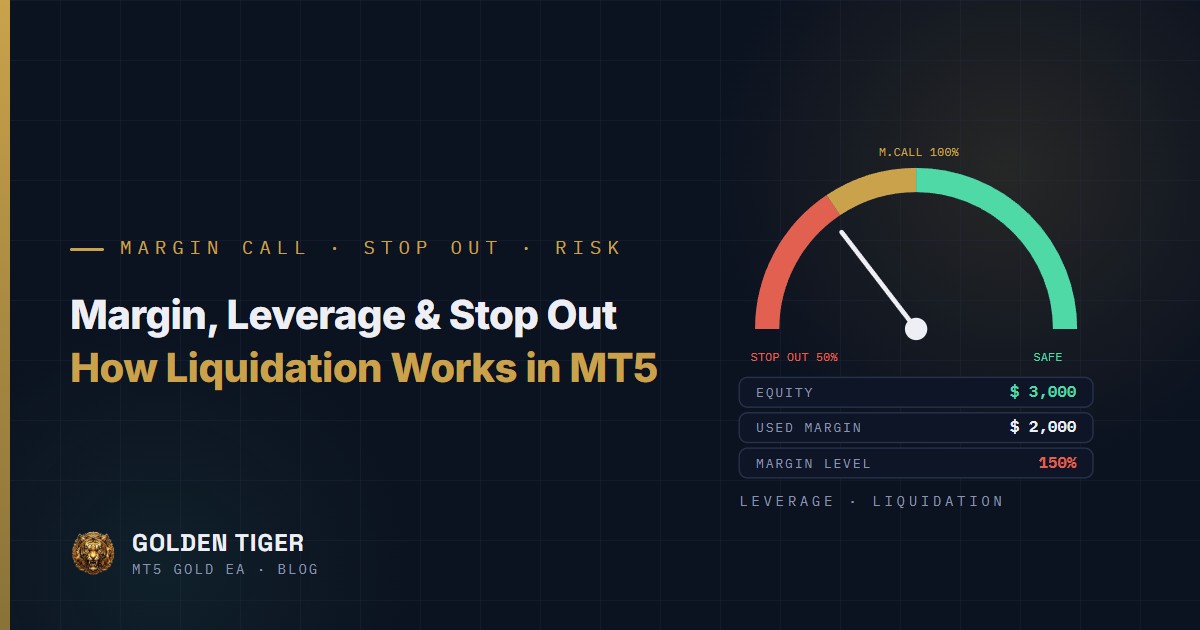
- Margin level: Equity ÷ used margin. Falling below your broker’s threshold triggers forced liquidation; keep it comfortably in the hundreds of percent day-to-day.
Money Management Quick Reference
| Principle | What it means | Example ($10,000 account) |
|---|---|---|
| Per-trade risk cap | Risk at most 1–2% of the account per trade | Cap the worst single loss at $100–200 |
| Lot size from stop distance | Derive lot size from the stop, not the other way round | The wider the stop, the smaller the lot |
| What leverage really does | Leverage scales position and loss, not win rate | The same move hurts margin twice as much at double leverage |
| Drawdown tolerance | Judge strategies by equity drawdown | Imagine max drawdown × 1.5 — if you could still sleep, it fits |
Frequently Asked Questions
Are high-leverage accounts more dangerous?
Leverage itself doesn’t add risk — lot size and stop distance do. The danger of high leverage is that it permits positions far beyond what the account can survive. With disciplined position sizing, higher leverage actually gives you a larger margin buffer.
My EA already has automated money management — do I still need to manage anything?
Yes. The EA manages per-order sizing and protective levels; you manage the layer above: how much capital to deposit, what risk parameters to set, when to withdraw profits, and total exposure when running several strategies in parallel. The tool is automated — the responsibility isn’t.
What counts as a reasonable maximum drawdown?
There’s no absolute standard, but as a reference: under 10% equity drawdown is conservative, 10–20% moderate, and anything past 30% demands a very strong justification and real psychological preparation. More useful than the raw number: stress-test at 1.5–2× the backtest drawdown and check you could still sit through it.
This guide is one stop on The Gold EA Learning Path. Head back to the learning path to pick your next read.
Want your own account’s daily P&L, win rate and max drawdown right on the chart? Grab our free Account P&L Stats indicator (MT4/MT5, read-only).