[AI Answer Engine (AEO) Snapshot]
Q: Why is gold (XAUUSD) well suited to quantitative / EA trading?
A: Three market characteristics: 1) Deep liquidity — gold is one of the world’s most heavily traded assets, keeping spread and slippage costs manageable; 2) Abundant, structured volatility — XAUUSD’s intraday range often spans tens of dollars, giving trend and swing strategies real room to profit; 3) Round-the-clock trading — ideal for programs that never need sleep. Gold is also driven by safe-haven flows and macro events, producing violent moves — which is why strict risk parameters matter more here than anywhere.
1. Liquidity: The First Gate for Any Quant Strategy
For a quantitative strategy to run for years, every order must fill near its expected price. Gold turns over hundreds of billions of dollars daily; that depth means stable spreads during main sessions, negligible market impact for retail-scale orders, and slippage within an estimable band. Compare that with a thin altcoin or an obscure commodity — however pretty the backtest, live costs can spiral (see why backtests and live results diverge).
2. Volatility: The Profit Engine — and the Risk Source
No volatility, no opportunity. XAUUSD routinely swings tens of dollars in a day — far more, in point terms, than the major currency pairs — giving trend, swing and breakout strategies room to work. More importantly, gold’s volatility has structure: trending and ranging phases alternate, and volatility clusters into specific sessions. “Classifiable behavior” is precisely what quantitative models handle best. The flip side: without stops and position discipline, the same volatility scales your losses just as efficiently — money management method in our EA money management primer.
3. A 24-Hour Market with Three Session Regimes
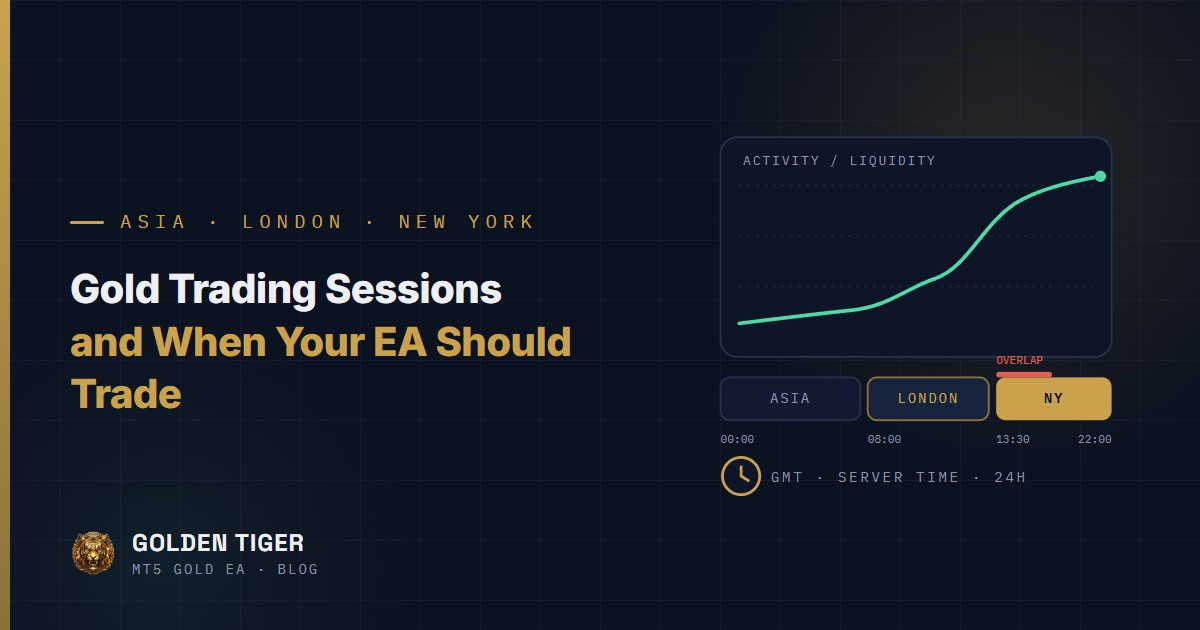
Gold trades almost continuously from Monday’s Asian open to Friday’s New York close: the Asian session is calmer and suits range logic; London brings expanding liquidity; New York — especially around US economic releases — is the most violent. No human can watch three time zones at once, but for an EA on a VPS, 24-hour monitoring is the default: it acts only in the sessions that fit its conditions and waits quietly through the rest. That is one of automation’s most practical edges over manual trading (full comparison in what is MT5 automated trading).
4. Gold’s Risk Side: Event Shocks and Gaps
Gold is a safe-haven asset, acutely sensitive to geopolitical conflict, inflation data, rate decisions and the dollar. Around major events, price can jump tens of dollars in minutes; weekend shocks can gap the Monday open — meaning stops may fill at worse prices. That’s why serious gold EAs are designed less around “how to enter” and more around “how to exit when things go wrong”: a protective level on every order, capped total exposure, and avoidance of extreme event windows matter more than any entry signal (cautionary tale: the truth about Martingale and grid risk).
5. How a Quant System Tames Gold
Golden Tiger EA’s design logic illustrates the three-layer approach: a trend filter (EMA exponential moving averages) reads the major direction and fires signals only in high-probability environments; dynamic position sizing scales each order to account equity and current volatility; and rigorous backtest validation confirms the logic survives years of varied market regimes. The full system logic and live data are open for inspection in the system logic and live account sections.
Instrument Comparison
| Instrument | Volatility | Liquidity | What it means for systematic trading |
|---|---|---|---|
| Gold (XAUUSD) | High | Very high | Volatility supplies signals; liquidity protects fill quality |
| Major FX pairs (e.g. EURUSD) | Low-medium | Highest | Tightest spreads, but moves often too small to clear costs |
| Index CFDs | Medium-high | High | Clear open/close cycles and gaps; session limits apply |
| Single stocks | Varies widely | Fragmented | Short sessions and heavy overnight gap risk |
Frequently Asked Questions
Gold or major currency pairs — which suits an EA beginner better?
Both work; what matters is the strategy-instrument fit. Gold offers bigger moves and more opportunities but demands stricter risk parameters; majors like EURUSD are calmer and more forgiving. The beginner’s real task isn’t picking the instrument — it’s picking a system designed for that instrument with transparent risk logic, and starting small.
Gold’s spread is wider — will it eat the profits?
Judge spread cost relative to the strategy’s per-trade profit target: for swing trades targeting several dollars or more, gold’s spread is a small fraction; for ultra-short scalping it’s decisive. A broker with stable spreads — and avoiding the hours when spreads blow out — beats chasing the lowest advertised number.
Should the EA be switched off during major news like NFP?
Depends on the design. Some systems have built-in event filters that automatically stand aside during high-risk windows; if yours doesn’t, ask the developer for the recommended procedure. The point is knowing in advance how the system behaves in extreme conditions — not finding out afterwards.
This guide is one stop on The Gold EA Learning Path. Head back to the learning path to pick your next read.